Are New Jersey's Highest-PFOA Water Systems Actually Filtering It Out?
A follow-up on the top PFOA results from EPA data finds a split record: several utilities now report non-detectable post-treatment samples, while others are still building treatment or still reporting detectable PFAS.
By Ryan
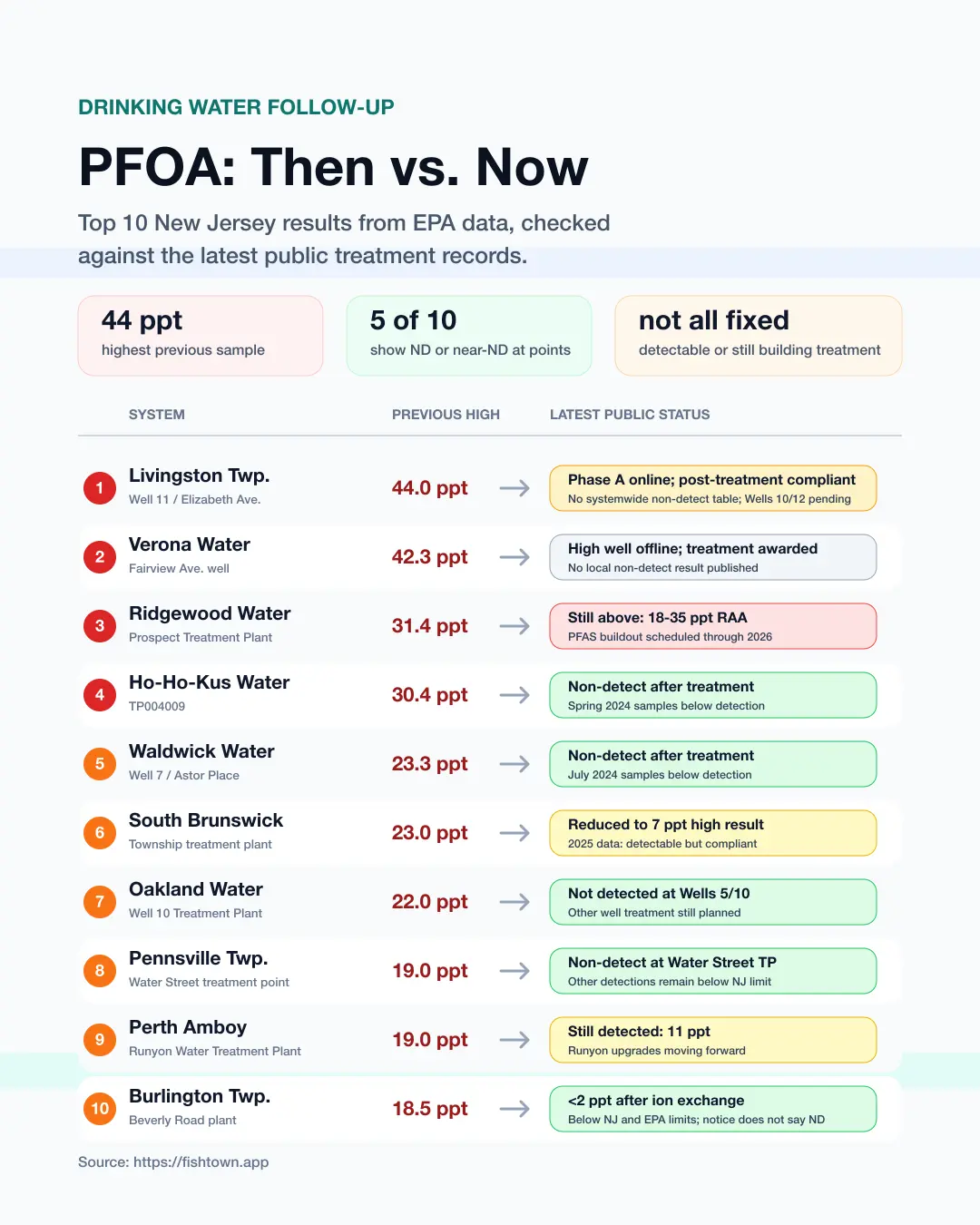
The first story looked at a simple public-health question: if PFOA is a cancer-linked forever chemical, what does it mean when public drinking-water reports show it above legal limits?
This follow-up asks the infrastructure question that matters next: after the notices, contracts, council meetings, and treatment projects, are the filters actually pushing PFOA and PFOS down to non-detectable levels?
The answer is mixed. Some systems have public closeout notices saying post-treatment samples are below detection. Others are still in phased construction. A few are legally in compliance but still reporting detectable PFAS, which is not the same thing as non-detect.
How this check was done
This story uses the top 10 New Jersey water systems from the prior article's EPA UCMR 5 PFOA ranking. Those rankings were based on the highest individual PFOA sample found in EPA's public UCMR 5 data, not a townwide annual average and not necessarily a current finished-water result.
This follow-up reviewed public notices, annual drinking-water reports, utility PFAS pages, council-meeting pages, and video/archive pages where available. "Non-detect" is only used here when the public record says the sample was non-detect, below detection, or not detected. "In compliance" means the system says it is under the applicable regulatory limit, but that can still include detectable PFAS.
New Jersey's state drinking-water limits are 14 parts per trillion for PFOA and 13 parts per trillion for PFOS. EPA's federal rule sets PFOA and PFOS limits at 4 parts per trillion, with compliance deadlines still rolling in nationally.
The top 10 check
| Rank from first story | Water system | Public engineer/operator tied to treatment records | Highest PFOA sample in the first story | What the latest public record shows | Is it non-detect now? |
|---|---|---|---|---|---|
| 1 | Livingston Township Division of Water | Nathan Kiracofe, township utility engineer, was named as the authorized representative for the PFAS loan projects. The public treatment update does not name an outside engineer. | 44 ppt | Phase A treatment for Wells 1, 4, and 11 is fully online, with water from Wells 1, 2, 4, 8, and 11 being treated for PFAS as of December 2025. The Q4 2025 notice still showed running annual averages above the PFOA limit at Well 4 and Well 11, but says recent post-treatment samples at those sites were in compliance. Phase B for Wells 10 and 12 is still scheduled for completion in 2026. | Not proven systemwide. Phase A is working toward compliance, but the public notice does not give a clean non-detect table for every formerly high point. |
| 2 | Verona Water Department | Jacobs Engineering Group Inc. is named for PFAS professional services at the Linn Drive and Fairview Avenue well sites. Sovereign Consulting was awarded the Fairview construction contract. | 42.3 ppt | Verona stopped using the Fairview Avenue well in 2021 and has been buying all drinking water from Passaic Valley Water Commission while local PFAS treatment is built. On July 21, 2025, council awarded a $2.799 million Fairview Avenue Well Facility PFAS treatment contract. | No public non-detect result found for the Fairview well. The current customer water is from another supplier that Verona says does not exceed the PFOA standard. |
| 3 | Ridgewood Water | Mott MacDonald is named as engineer of record for one PFAS facility and was awarded bid/construction-phase professional engineering for several PFAS facilities. Ridgewood also names Sovereign Consulting as a construction contractor at Wortendyke. | 31.4 ppt | Ridgewood's July 2025 repeat notice still listed PFOA running annual averages above the state limit at 22 points of entry, with PFOA RAAs between 18 and 35 ppt. Ridgewood says the system is being consolidated through 12 PFAS treatment facilities; some are complete, others remain under construction or in final engineering, with all 12 scheduled for completion by the end of 2026. | No. Ridgewood is still a construction and compliance story, not a non-detect closeout story. |
| 4 | Ho-Ho-Kus Water Department | The final closeout notice does not clearly name the project engineer. | 30.4 ppt | Ho-Ho-Kus says new treatment went into service March 26, 2024. Samples collected March 26, April 2, and April 9, 2024 were below detection for PFOA and PFNA at all locations. | Yes, according to the borough's final public notice. |
| 5 | Waldwick Water Department | H2M is the firm in the public water-quality presentation record. The final closeout notice itself does not name the project engineer. | 23.3 ppt | Waldwick says new PFAS treatment systems went into service in early July 2024. Samples collected July 9 and July 16, 2024 were below detection for PFOA and PFOS at all locations. | Yes, according to Waldwick's final public notice. |
| 6 | South Brunswick Township Water Division | Alaimo Associates was appointed utilities consulting engineer for 2026. Available public records do not include a PFAS-specific filtration design contract. | 23 ppt | South Brunswick's 2026 report, based on 2025 data, shows PFOA with a highest result of 7 ppt, a range from not detected to 7 ppt, and running annual averages from 2.59 to 11.10 ppt. PFOS ranged from not detected to 5 ppt. | No. In compliance, but still detected. |
| 7 | Oakland Water Department | Boswell Engineering is named for PFAS treatment-system engineering at the Soons Well Field; earlier minutes also reference a Boswell PFAS report. | 22 ppt | Oakland's mayor said PFAS treatment facilities at Well 5 and Well 10 were operational by spring 2024 and that lab results at those wells were "not detected" for PFAS chemicals. The same update said a Well 9 system would be operational soon and that other remaining wells were planned for PFAS treatment. | Yes for Wells 5 and 10, according to the mayor's update. Not proven for every well. |
| 8 | Pennsville Township Water Department | Environmental & Technical Services LLC is the licensed operator named on the closeout notice, and ETS lists PFAS GAC permitting/design work in its project examples. | 19 ppt | Pennsville's February 2024 notice said PFOA at the Water Street treatment plant had a 15 ppt running annual average and that two granular activated carbon vessels were being installed. The August 2024 closeout notice says the Aug. 14 sample was non-detect for PFOA. The 2025 annual report still shows detectable PFOA at other sample points, but below the 14 ppt state limit. | Yes at the remediated Water Street treatment point; not systemwide non-detect. |
| 9 | Perth Amboy Water Department | USA-PA / Middlesex Water operate the system and describe capital upgrades, but available public records do not name a current PFAS filtration engineer for the Runyon work. | 19 ppt | Perth Amboy's 2025 report lists PFOA at 11 ppt, with a range of 9.4 to 12.3 ppt, and PFOS at 3.8 ppt, with a range of 3.1 to 4.3 ppt. The city says Runyon Water Treatment Plant upgrades are moving forward and a federal funding update says the work will strengthen the plant's ability to address PFAS and other emerging contaminants. | No. Detectable PFAS remains in the latest public annual report. |
| 10 | Burlington Township Water Department | T&M Associates says it evaluated PFAS treatment options for the Beverly Road Water Treatment Plant, designed the ion-exchange treatment system, prepared the NJDEP permit, and provided bidding and construction oversight. | 18.5 ppt | Burlington Township says ion-exchange equipment was completed at the Beverly Road Water Treatment Plant as of Aug. 13, 2024. Samples collected Aug. 21 and Sept. 11, 2024 showed PFOA below 0.002 ppb, or less than 2 ppt. | Near non-detect / below 2 ppt. The notice says less than 2 ppt, not "non-detect." |
Which engineers show up?
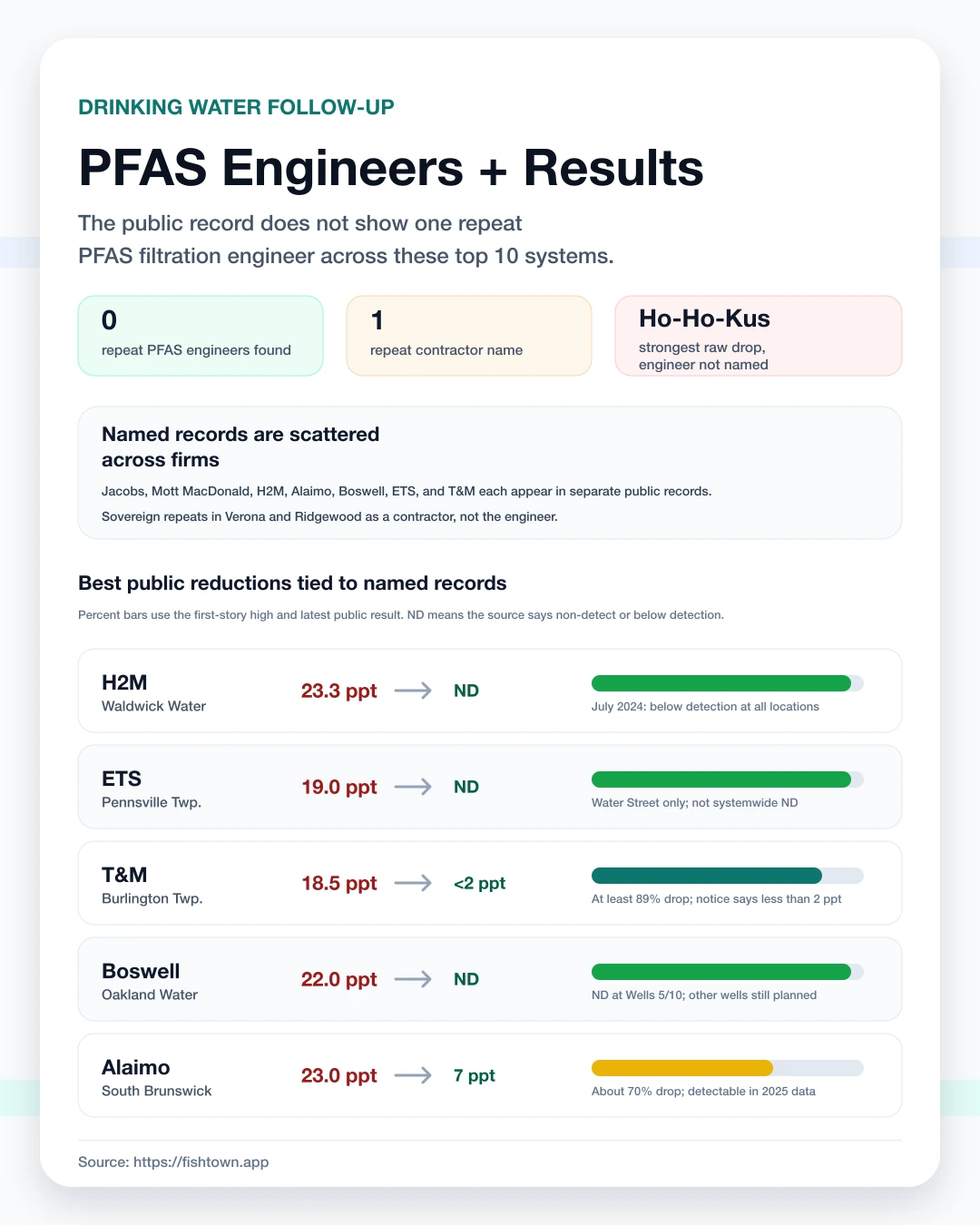
No single engineering firm clearly repeats as the named PFAS filtration engineer across these 10 systems. The named engineering or operator records point to different firms: Jacobs in Verona, Mott MacDonald in Ridgewood, H2M in Waldwick's public presentation record, Alaimo in South Brunswick's utilities-consulting record, Boswell in Oakland, ETS in Pennsville's operator/project record, and T&M in Burlington Township.
One name does repeat if the category is broadened beyond engineers: Sovereign Consulting appears in Verona's Fairview Avenue construction award and Ridgewood's Wortendyke construction update. That is a contractor overlap, not an engineer overlap, because the public records identify Sovereign as a construction contractor while the engineering records name other firms.
The best public reductions tied to named engineering or operator records look like this:
| Named engineer/operator record | System | Public result after treatment | Reduction note |
|---|---|---|---|
| H2M, public presentation record | Waldwick Water Department | Below detection for PFOA and PFOS at all locations in July 2024 samples | From a 23.3 ppt high in the first story to non-detect in the closeout notice. |
| Environmental & Technical Services LLC / ETS | Pennsville Township Water Department | Non-detect for PFOA at the Water Street treatment point on Aug. 14, 2024 | From a 19 ppt high in the first story to non-detect at the remediated point, but not systemwide non-detect. |
| T&M Associates | Burlington Township Water Department | Less than 2 ppt after ion exchange at Beverly Road | From an 18.5 ppt high in the first story to less than 2 ppt, or at least about an 89% drop. The notice does not call it non-detect. |
| Boswell Engineering, Oakland PFAS engineering record | Oakland Water Department | Not detected at Wells 5 and 10, according to the mayor's update | From a 22 ppt high in the first story to not detected at those wells, but the public record does not prove every well is finished. |
| Alaimo Associates, 2026 utilities-consulting record | South Brunswick Township Water Division | Latest 2025-data report shows a high PFOA result of 7 ppt | From a 23 ppt high in the first story to a 7 ppt high result, roughly a 70% drop, but still detectable and not tied to a specific filtration design contract. |
Ho-Ho-Kus may be the strongest raw treatment outcome in the whole group: 30.4 ppt in the first story, then below detection after treatment in spring 2024. The closeout materials do not provide a clean public engineer name, so that reduction is not assigned to a firm here.
What the fixes cost
The public cost record is not apples-to-apples. A construction award, a Water Bank financing package, an engineering contract, and a federal allocation are different records. But the numbers show the scale of the fixes and how unevenly that spending is disclosed.
| Water system | Public cost record | What it covers |
|---|---|---|
| Livingston Township Division of Water | $14.19 million across Phases A, B, and C | NJ Water Bank financing for phased PFAS treatment: $8.75 million for Phase A, $3.34 million for Phase B, and $2.09 million for Phase C. |
| Verona Water Department | $2.799 million construction award, plus $47,000 and $268,000 in Jacobs professional-service increases | Fairview Avenue PFAS treatment construction and professional services tied to the Linn Drive and Fairview Avenue well sites. |
| Ridgewood Water | $89 million earlier centralized-treatment estimate; current public project entries list about $81.4 million in PFAS/raw-water-main amounts | A large systemwide PFAS treatment buildout, with 12 treatment facilities scheduled for completion by the end of 2026. |
| Waldwick Water Department | Up to $5 million, with $500,000 in debt forgiveness and $1.058 million in ARP funds applied | Municipal PFAS treatment-system financing. |
| Oakland Water Department | $201,000 not-to-exceed Boswell engineering award | Engineering services for the Soons Well Field PFAS treatment system. |
| Perth Amboy Water Department | $1 million federal allocation | Runyon Water Treatment Plant upgrades; this is not a full project-total number. |
| Ho-Ho-Kus / South Brunswick / Pennsville / Burlington Township | No clean comparable total located in public records | Public records show treatment status, treatment scope, or closeout results, but not a comparable PFAS project total. |
Ridgewood is the caveat. The $89 million figure is an earlier village estimate for centralized treatment, while the roughly $81.4 million figure comes from current listed project entries. They point to the same order of magnitude, not necessarily the same accounting bucket.
What the meeting and video record shows
The best public trail is not the same in every town. Some systems post exact meeting videos, some post meeting pages and resolutions, and some only post public notices or annual reports. That is a transparency problem for residents trying to understand whether a treatment plant is actually working.
The strongest video record is in Waldwick, where the borough water page embeds public water-quality presentations. One 2026 H2M presentation is linked below, starting at the water-quality discussion.
Other public meeting and video links:
- Livingston: Council Meeting Videos and the PFAS construction update, which says Phase A was awarded June 26, 2023 and became fully online in December 2025.
- Verona: July 21, 2025 council meeting page listing the Fairview Avenue PFAS treatment award, Resolution 2025-172, and Verona's council video playlist.
- Ridgewood: Ridgewood Water PFAS resources, PFAS quarterly notices, and the Village's Swagit meeting video archive.
- Waldwick: PFAS information page, H2M water-quality presentation, and virtual public presentation.
- South Brunswick: live meeting access page and the 2026 water quality report. Available public records do not include a clean archived council video tied to PFAS treatment.
- Oakland: mayor's PFAS update and the borough's official YouTube channel.
- Pennsville: PFOA public notice, closeout notice, annual report, and minutes/agendas page. Available public records do not include a clean archived meeting video.
- Perth Amboy: 2025 annual water quality report, Runyon plant funding update, and May 13, 2026 council meeting summary.
- Burlington Township: PFOA closeout notice and meeting agendas/minutes page.
What is working
The cleanest wins are Ho-Ho-Kus and Waldwick. Their closeout notices do not just say "in compliance"; they say treatment was installed and later samples were below detection at all locations for the regulated PFAS compounds named in the notices.
Oakland also has strong language for Wells 5 and 10, where the mayor reported not-detected PFAS results after treatment came online. But the same update says other wells still had treatment planned, so that is not the same as a systemwide all-wells non-detect statement.
Pennsville is another partial win. The Water Street treatment point that triggered the notice went non-detect after granular activated carbon treatment, according to the closeout notice. But Pennsville's annual report still shows PFOA detections elsewhere in the system, below the state limit.
Burlington Township is close, but the wording matters. Its notice says PFOA fell to less than 2 ppt after ion-exchange treatment. That is far below New Jersey's 14 ppt state limit and below EPA's 4 ppt federal limit, but the notice does not use the words non-detect.
What is not finished
Ridgewood is the clearest unfinished case. Its public materials show a large PFAS treatment buildout, but its July 2025 notice still listed 22 entry points above the PFOA limit. Ridgewood says some treatment facilities are complete, others are under construction or in final engineering, and all 12 are scheduled for completion by the end of 2026. That is progress, not a finished cleanup.
Livingston is also still in the transition zone. Phase A is online and recent samples at some Phase A treatment plants were in compliance, but the Q4 notice still carried above-limit running annual averages because those averages included older pre-treatment quarters. Wells 10 and 12 are still in Phase B.
Verona is a different kind of unfinished case. Residents are not being supplied from the high-PFOA Fairview well; Verona says it has been buying water from Passaic Valley Water Commission while local wells are remediated. But as of the July 2025 council record, the Fairview PFAS treatment project was still a contract award, not a completed non-detect result.
South Brunswick and Perth Amboy both show why "legal" and "gone" are not the same word. Their latest public annual reports show no PFOA violation under New Jersey's limit, but PFOA is still detectable.
The takeaway
Filters can work. The closeout notices from Ho-Ho-Kus, Waldwick, Pennsville, Oakland, and Burlington show that treatment can knock PFOA/PFOS down sharply, sometimes to below detection.
But the public record also shows how long this takes. Towns can spend years sending repeated notices while running annual averages lag behind construction, wells are shut off, water is purchased from another supplier, or treatment plants are still being built.
For residents, the next question at every water meeting should be specific: not just "Are we in compliance?" but "What was the latest post-treatment PFOA and PFOS result at each entry point, and was it non-detect?"
Source: EPA UCMR 5 Occurrence Data, NJDEP PFAS standards, municipal public notices, annual water quality reports, treatment-cost records, and meeting/video links listed above.
Sources
- Original PFAS Articlefishtown.app
- EPA UCMR 5 Occurrence Dataepa.gov
- NJDEP PFAS Facts and Standardsdep.nj.gov
- Livingston PFAS Treatment Construction Updatelivingstonnj.org
- Livingston PFAS Loan Authorization Naming Utility Engineerlivingstonnj.org
- Livingston Q4 2025 PFOA Public Noticelivingstonnj.org
- Livingston Council Meeting Videoslivingstonnj.org
- Verona PFOA Public Noticeveronanj.org
- Verona July 21, 2025 Council Meetingveronanj.org
- Verona Fairview Avenue PFAS Treatment Contract Resolutionevogov.s3.us-west-2.amazonaws.com
- Verona Jacobs PFAS Professional Services Resolutionveronanj.org
- Verona 2025 Jacobs PFAS Professional Services Resolutionevogov.s3.us-west-2.amazonaws.com
- Verona Council Meeting Video Playlistyoutube.com
- Ridgewood PFAS Quarterly Noticeswater.ridgewoodnj.net
- Ridgewood PFAS Resources and Construction Updatewater.ridgewoodnj.net
- Ridgewood PFAS Project Cost Advisorywater.ridgewoodnj.net
- Ridgewood Mott MacDonald PFAS Engineering Archivearchive.ridgewoodnj.net
- Ridgewood Centralized PFAS Treatment Estimate Archivearchive.ridgewoodnj.net
- Ridgewood Meeting Video Archiveridgewoodnj.new.swagit.com
- Ho-Ho-Kus PFOA Final Public Noticehhkborough.com
- Waldwick PFAS Final Public Noticewaldwicknj.gov
- Waldwick PFAS Information and Meeting Videoswaldwicknj.gov
- Waldwick PFAS Financing Updatewaldwicknj.gov
- South Brunswick 2026 Drinking Water Quality Reportsouthbrunswicknj.gov
- South Brunswick Utilities Consulting Engineer Resolutionsouthbrunswicknj.gov
- South Brunswick Live Meeting Accesssouthbrunswicknj.gov
- Oakland Mayor's PFAS Updateoakland-nj.org
- Oakland Boswell PFAS Engineering Contractoakland-nj.org
- Pennsville PFOA Public Noticepennsville.org
- Pennsville PFOA Closeout Noticepennsville.org
- Pennsville 2025 Drinking Water Quality Reportpennsville.org
- ETS PFAS Treatment Project Examplesenvironmentaltechnicalservices.com
- Perth Amboy 2025 Annual Water Quality Reportmiddlesexwater.com
- Perth Amboy Runyon Plant Funding Updateperthamboynj.org
- Perth Amboy May 13, 2026 Council Meeting Summaryapp.govly.com
- Burlington Township PFOA Closeout Noticetwp.burlington.nj.us
- T&M Burlington PFAS Treatment Projecttandmassociates.com