This Cancer-Causing Chemical Is Above Regulatory Standards. Can It Still Cause Cancer in Our Drinking Water?
A cancer-causing forever chemical is above the legal limit nearby. What does that actually mean for the water we drink?
By Ryan
Editor's note, May 23, 2026: This story was updated to add Bordentown Water Department data, source links, Trenton Water Works emergency-supply context, and New Jersey PFOA sample results above the state limit found in EPA UCMR 5 data.
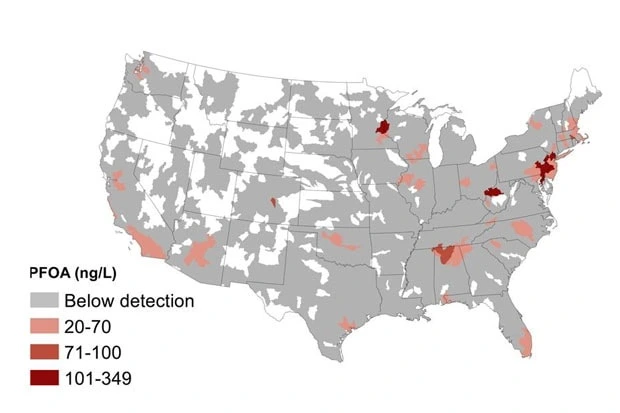
The honest answer is: not in the simple way people usually mean when they ask that question.
PFOA, short for perfluorooctanoic acid, is one type of PFAS: the family of long-lasting manufactured chemicals often called "forever chemicals." It was used in industrial and consumer products because it resists heat, oil, grease, stains, and water.
PFOA is not a chemical where one glass of water can be blamed for one cancer diagnosis. The concern is long-term exposure. Regulators and cancer researchers now treat PFOA as a serious health risk because it persists in water, builds up in people, and has been linked to kidney and testicular cancer over time.
Legally, public water systems are judged against maximum contaminant levels. Public-health-wise, the goal should be more ambitious: treatment should push PFOA as close to non-detectable as possible, because "below the limit" is not the same thing as "gone."
That matters here because Florence Township, upstream on the New Jersey side of the Delaware, is still dealing with PFOA in its drinking-water system. Florence is not Philadelphia's water system, and it is not proof that Fishtown tap water is unsafe. But it is a useful nearby example of how PFAS problems show up: not always as a dramatic river spill, but as a well, an aquifer, a quarterly test, and years of treatment planning.
What nearby systems report
These are not real-time tap readings, and the reporting periods are not identical. They are the latest public PFOA numbers I found from water-system reports, utility PFAS pages, and public notices.
| Water system / place | Latest public PFOA number | What the source says |
|---|---|---|
| Philadelphia Water Department | Highest result 6.1 ppt; system-wide range 2.6-6.1 ppt | 2025 data table; no 2025 violation under Pennsylvania's 14 ppt PFOA MCL. The report says EPA MCL compliance begins in 2029. |
| Aqua Pennsylvania - Bensalem / Neshaminy Treated Water | 6.7 ppt | Water Facts result dated 12/3/2025. |
| Aqua Pennsylvania - Bristol Treated Water / Delaware River source | Not detected | Water Facts result dated 11/20/2025. Bristol Township wells also have PFAS treatment installed as of 11/13/2025. |
| Burlington Township Water Department / Beverly Road WTP | Less than 2 ppt after treatment | September 2024 closeout notice says the prior running annual average was 16 ppt, then ion-exchange treatment brought samples below 2 ppt. |
| Bordentown Water Department | Not detected / below EPA UCMR 5's 4 ppt reporting level | EPA UCMR 5's January 2026 data file still lists Bordentown's latest public PFOA sample events as January 10 and July 24, 2024, both less than 0.004 ug/L. Bordentown's normal source is groundwater, but Trenton Water Works agreed in August 2024 to temporarily supply water during emergency plant and pressure repairs. |
| Trenton Water Works | Not detected / below EPA UCMR 5's 4 ppt reporting level | EPA UCMR 5 lists Trenton Water Works PFOA results below 0.004 ug/L for April 19, October 27, and October 31, 2023, plus January 22, 2024. TWW's consumer confidence report says its source water is drawn from the Delaware River and treated at the Route 29 filtration plant. |
| City of Camden system | Highest LRAA 9.4 ppt; range not detected-10.2 ppt | 2024 data in the 2025 Annual Water Quality Report. |
| Delaware River Regional Water Treatment Plant | Highest result 3.9 ppt; range not detected-3.9 ppt | 2024 data in the Camden report's purchased-water section. |
| Florence Township | 16 ppt running annual average | January 2026 notice; above New Jersey's 14 ppt PFOA standard. |
Sources: Philadelphia Water Department 2025 Drinking Water Quality Report, Aqua Pennsylvania Water Facts - Bensalem Township, Aqua Pennsylvania Water Facts - Bristol Township, Burlington Township PFOA Closeout Notice, EPA UCMR 5 Occurrence Data, Jersey WaterCheck - Bordentown Water Department, City of Bordentown Water Department, Trenton Water Works Bordentown Supply Announcement, Trenton Water Works 2024 Consumer Confidence Report, Camden 2025 Annual Water Quality Report, and Florence Township PFOA Resident Notification.
The New Jersey PFOA samples I found above the state limit
Florence is not the highest PFOA result in New Jersey's current public drinking-water dataset. In EPA's UCMR 5 state file, the highest individual New Jersey PFOA sample I found was in Livingston Township: 44 parts per trillion at Well 11 / Elizabeth Avenue on April 3, 2025. That is more than three times New Jersey's 14 ppt PFOA drinking-water standard, but it is also a historical sample from before Livingston's Phase 1 treatment facilities were fully online.
The current EPA UCMR 5 file shows 17 New Jersey public-water systems or school systems with at least one detected PFOA sample above 14 ppt. These are individual sample results, not townwide annual averages and not a statement that every tap in the community had that concentration.
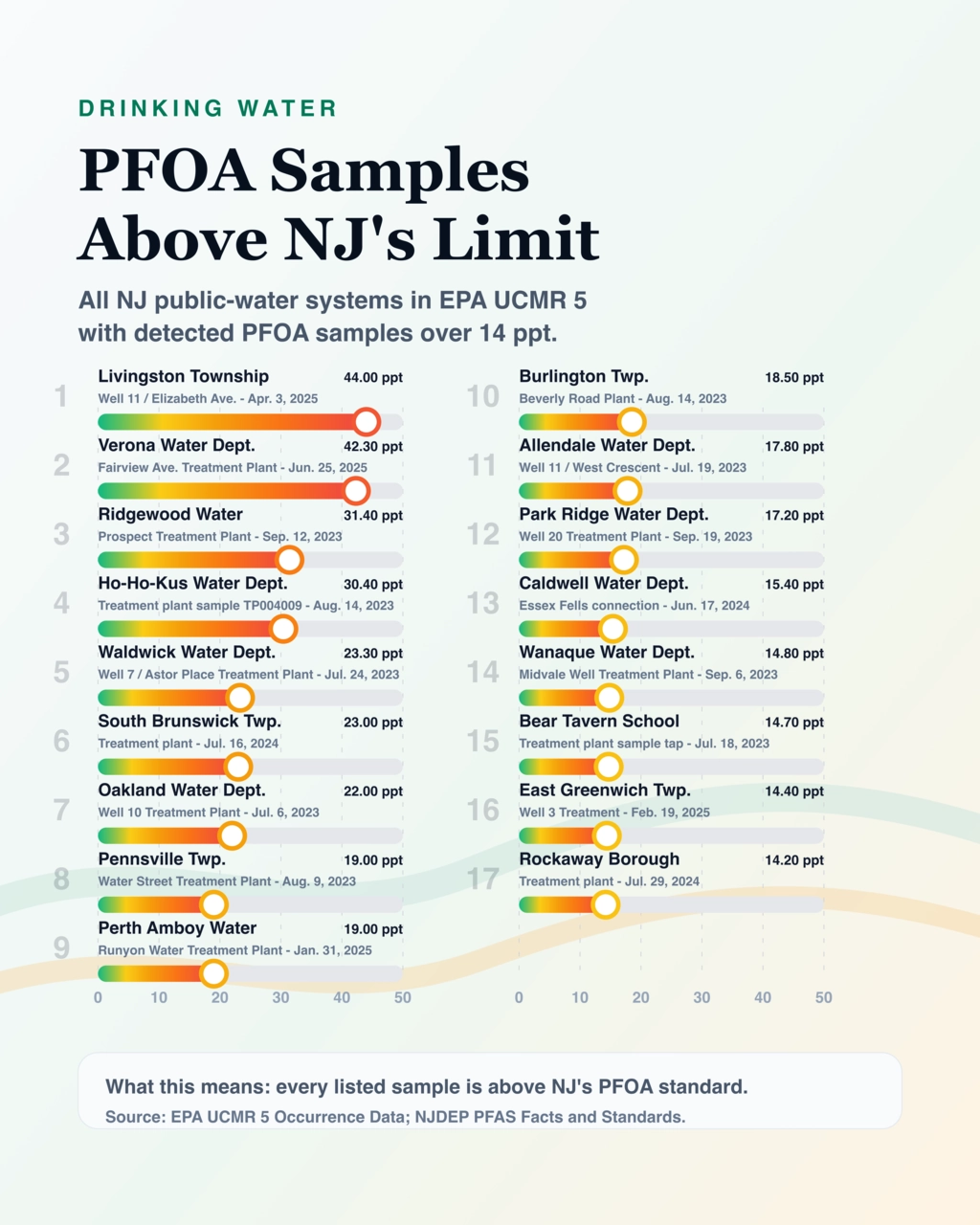
| Rank | Water system / place | Sample point | Sample date | Highest PFOA sample |
|---|---|---|---|---|
| 1 | Livingston Township Division of Water | Well 11 / Elizabeth Avenue; entry point to distribution system | April 3, 2025 | 44 ppt |
| 2 | Verona Water Department | Fairview Avenue Treatment Plant; entry point to distribution system | June 25, 2025 | 42.3 ppt |
| 3 | Ridgewood Water | Prospect Treatment Plant; entry point to distribution system | September 12, 2023 | 31.4 ppt |
| 4 | Ho-Ho-Kus Water Department | Treatment plant sample point TP004009 | August 14, 2023 | 30.4 ppt |
| 5 | Waldwick Water Department | Well 7 / Astor Place Treatment Plant | July 24, 2023 | 23.3 ppt |
| 6 | South Brunswick Township Water Division | Treatment plant | July 16, 2024 | 23 ppt |
| 7 | Oakland Water Department | Well 10 Treatment Plant; entry point to distribution system | July 6, 2023 | 22 ppt |
| 8 | Pennsville Township Water Department | Treatment Plant 1 / Water Street; entry point to distribution system | August 9, 2023 | 19 ppt |
| 9 | Perth Amboy Water Department | Runyon Water Treatment Plant; entry point to distribution system | January 31, 2025 | 19 ppt |
| 10 | Burlington Township Water Department | Beverly Road Plant; entry point to distribution system | August 14, 2023 | 18.5 ppt |
| 11 | Allendale Water Department | Well 11 / West Crescent | July 19, 2023 | 17.8 ppt |
| 12 | Park Ridge Water Department | Well 20 Treatment Plant; entry point to distribution system | September 19, 2023 | 17.2 ppt |
| 13 | Caldwell Water Department | Essex Fells connection / Runnymead Road entry point | June 17, 2024 | 15.4 ppt |
| 14 | Wanaque Water Department | Midvale Well Treatment Plant; entry point to distribution system | September 6, 2023 | 14.8 ppt |
| 15 | Bear Tavern School | Treatment plant sample tap | July 18, 2023 | 14.7 ppt |
| 16 | East Greenwich Township Water Department | Well 3 Treatment / 185 County House Road | February 19, 2025 | 14.4 ppt |
| 17 | Rockaway Borough Water Department | Treatment plant | July 29, 2024 | 14.2 ppt |
Sources: EPA UCMR 5 Occurrence Data for sample results; NJDEP PFAS Facts and Standards for New Jersey's 0.014 ug/L, or 14 ppt, PFOA standard.
Livingston's number also needs a current-status footnote. The 44 ppt UCMR 5 result is useful for showing the scale of the problem, but Livingston's own February 2026 materials say the system has changed since then. The township says Phase 1 PFAS treatment is online and operational, four well facilities are now in full compliance with NJDEP PFAS standards, and water from Wells 1, 2, 4, 8, and 11 is being treated for PFAS.
Livingston's February 2026 public notice still lists fourth-quarter 2025 running annual averages above the PFOA limit at some treatment plants, including 18 ppt at Well 4 and 24 ppt at Well 11. But the same notice says recent post-treatment samples at Wells 4 and 11 were in compliance, and that some running annual averages remained high because they still included older pre-treatment quarters. Well 10, the well with the highest PFOA history, has been shut down since September 2021 and is not expected to be used again until treatment is installed.
What Florence found
Florence Township's public notice says its running annual average for PFOA is 0.016 parts per billion. New Jersey's drinking-water limit for PFOA is 0.014 parts per billion, so Florence remains above the state standard.
Put another way, 0.016 ppb is 16 parts per trillion. EPA's national drinking-water rule now sets the enforceable PFOA limit at 4 parts per trillion, with public water systems required to monitor and, if needed, install treatment on a federal timeline.
Florence says it first exceeded the PFOA limit in September 2022 and failed to bring the system back into compliance by the one-year deadline in September 2023. The town says it has been testing PFAS for the last three years, that the high-result well is offline, and that it must complete construction and place a permanent PFAS treatment system into operation by December 31, 2027.
Township documents show how slow and expensive this gets. In October 2024, Florence authorized an administrative consent order with NJDEP after hiring Remington & Vernick Engineers to study PFAS in the water system and design treatment to remove PFAS from drinking water. In March 2025, Council approved a $40,000 change order to extend pilot testing for 30 days because the filtration media had not yet shown breakthrough. The final engineering contract amount listed there was $650,910.
The larger construction project is in New Jersey's Water Bank pipeline. The SFY2026 project list includes Florence Township Water Treatment Plant Improvements at an estimated $14.6 million.
Is PFOA actually cancer-causing?
The International Agency for Research on Cancer, part of the World Health Organization, classifies PFOA as carcinogenic to humans. EPA's PFAS drinking-water rule also treats long-term PFAS exposure as a cancer and serious illness concern, which is why the federal PFOA and PFOS limits are now 4 parts per trillion.
That still does not mean every exposure produces cancer. It means the risk is serious enough that public water systems are being pushed toward monitoring, public notice, treatment, and lower long-term exposure.
Florence's own public notice uses the same long-term framing. It says people drinking water above the PFOA limit over time could see effects involving cholesterol, liver, kidney, immune, and male reproductive systems, and that the risk of testicular and kidney cancer may increase.
The practical part is blunt: boiling water does not remove PFOA. Florence's notice also says New Jersey health officials advise bottled water for infant formula and infant beverages when PFOA is elevated, and that pregnant or nursing women, or women considering pregnancy, may choose bottled water for drinking and cooking to reduce exposure.
The river spill was a different warning
The 2023 Trinseo spill in Bristol Township was not the same as Florence's PFAS problem. It was a synthetic latex product spill from a facility on a Delaware River tributary. Pennsylvania DEP said about 8,100 gallons of acrylic latex polymer were released, and the Philadelphia Water Department said the primary substances tested for included butyl acrylate, ethyl acrylate, and methyl methacrylate.
Still, the spill showed why the Delaware gets people nervous fast. PWD said the Trinseo facility was about 13 miles north of the Baxter Drinking Water Treatment Plant intake. The department later said contaminants from the discharge were never found in Philadelphia's water system, but the event was a live demonstration of how upstream industrial incidents can become downstream drinking-water alerts within hours.
Philadelphia's drinking water comes from the Delaware and Schuylkill rivers. Fishtown sits next to the Delaware, so even when a problem is technically upstream, across the river, or in a separate groundwater system, it is still part of the same regional water story.
Other towns are in this too
Florence is not an isolated case. New Jersey's Water Bank list includes multiple PFAS-related drinking-water projects, including Camden City's PFAS treatment improvements at the Morris-Delair Water Treatment Plant, Aqua New Jersey's Hamilton PFAS treatment, East Orange PFAS treatment, Ridgewood water treatment centralization for PFAS removal, Clinton well PFAS treatment, and Florence's own project.
Bordentown is worth separating from Florence. Jersey WaterCheck lists Bordentown Water Department as public water system NJ0303001, serving Bordentown City, Bordentown Township, and Fieldsboro, with drinking-water sources in the Potomac-Raritan-Magothy aquifer system. The state-facing dashboard says the system met primary drinking-water standards in 2024.
The latest public PFOA sample records I found for Bordentown are still from 2024, but the dataset itself is newer: EPA's UCMR 5 state file was packaged January 15, 2026 and still lists Bordentown PFOA samples only for January 10 and July 24, 2024. Both were reported as less than 0.004 ug/L, which is 4 parts per trillion. EWG's NJDEP-fed Bordentown PFOA page also lists those two 2024 results as not detected and shows no 2025 or 2026 PFOA sample entry.
There is a separate supply wrinkle. Bordentown's normal source is its own groundwater system, but in August 2024 Trenton Water Works and the City of Bordentown signed an agreement for TWW to supply water for the next several months while Bordentown worked on pressure, capacity, and high-lift pump repairs after flooding at its water-treatment plant. Trenton said that emergency connection would come from TWW's distribution system in Hamilton Township; TWW draws and treats water from the Delaware River. I did not find a newer public Bordentown-specific PFOA reading from the period after that temporary Trenton supply started.
The other visible issue there, from Jersey WaterCheck, is service-line inventory: 257 lead service lines and 2,128 lines of unknown composition reported in 2024.
On the Pennsylvania side, the best-known PFAS drinking-water fights have been in Bucks and Montgomery County communities including Horsham, Warrington, and Warminster, where the state health department is part of a PFAS health study focused on residents exposed through drinking water. Pennsylvania set state PFOA and PFOS drinking-water limits in 2023 before EPA's 2024 federal standards lowered the bar nationally.
The money is also scattered across different programs. EPA announced $33.626 million in new Emerging Contaminants grant funding for New Jersey in May 2026 and $39.252 million for Pennsylvania. EPA had already announced $75.086 million for Pennsylvania in 2023 to address emerging contaminants like PFAS in drinking water.
Pennsylvania's PENNVEST board said in January 2025 that it had already financed more than $67 million for nine PFAS projects across five counties, and that its total PFAS funding commitment had increased to more than $95 million after that board meeting. That round included Bucks County PFAS removal projects in Doylestown and Perkasie, plus several Aqua Pennsylvania PFAS projects in other counties.
In New Jersey, the Water Bank list is not one single PFAS cleanup pot, but it shows the scale of project-by-project treatment costs:
| Applicant | Project | Estimated project amount |
|---|---|---|
| Camden City | PFAS Treatment Improvements at Morris-Delair Water Treatment Plant | $74.3 million |
| Florence Township | Florence Township Water Treatment Plant Improvements | $14.6 million |
| Aqua New Jersey | Aqua Hamilton PFAS Treatment | $21 million |
Source: NJ Water Bank SFY2026 Project Priority List
The local takeaway
For Fishtown, the takeaway is not panic. It is attention.
Florence's problem is groundwater from its own public water system. The Trinseo spill was a separate industrial release to a Delaware River tributary. Philadelphia's drinking water is monitored and treated through its own system. Those are different facts.
But they point in the same direction: water safety is infrastructure, testing, public notice, and money. The cancer question is not really whether one glass causes cancer. It is whether long-term exposure to persistent chemicals is being taken seriously before residents spend years drinking around a problem they did not know was there.
Sources
- Florence Township PFOA Resident Notificationflorence-nj.gov
- Florence Resolution 2024-192florence-nj.gov
- Florence Resolution 2025-71florence-nj.gov
- NJ Water Bank SFY2026 Project Priority Listdspace.njstatelib.org
- IARC PFOA/PFOS Carcinogenicity Evaluationiarc.who.int
- EPA PFAS Drinking-Water Rule Fact Sheetepa.gov
- Philadelphia Water Department Trinseo Spill Responsewater.phila.gov
- PA DEP Delaware River Pollution Event Updatepa.gov
- EPA New Jersey PFAS Fundingepa.gov
- EPA Pennsylvania PFAS Fundingepa.gov
- PENNVEST January 2025 Water Infrastructure Fundingpa.gov
- Florence Township Utility Service Plan Elementflorence-nj.gov
- Philadelphia Water Department 2025 Drinking Water Quality Reportwater.phila.gov
- Aqua Pennsylvania Water Facts - Bensalem Townshipwaterfacts.com
- Aqua Pennsylvania Water Facts - Bristol Townshipwaterfacts.com
- Burlington Township PFOA Closeout Noticetwp.burlington.nj.us
- Camden 2025 Annual Water Quality Reportcamdennj.gov
- Environmental Pollution Centers PFOA Explainer Imageenvironmentalpollutioncenters.org
- Jersey WaterCheck - Bordentown Water Departmentnjwatercheck.com
- EPA UCMR 5 Occurrence Dataepa.gov
- NJDEP PFAS Facts and Standardsdep.nj.gov
- Fieldsboro 2025 Annual Drinking Water Quality Reportfieldsboro.us
- City of Bordentown Water Departmentcityofbordentown.com
- City of Bordentown August 12, 2024 Water Updatecityofbordentown.com
- Trenton Water Works Bordentown Supply Announcementtrentonnj.org
- Trenton Water Works 2024 Consumer Confidence Reporttrentonnj.org
- EWG Tap Water Database - Bordentown PFOAewg.org
- Livingston Q4 2025 PFOA Public Noticelivingstonnj.org
- Livingston February 2026 PFAS Cover Letterlivingstonnj.org
- Livingston PFAS Treatment Construction Updatelivingstonnj.org
- Livingston PFAS Drinking-Water Information Pagelivingstonnj.org